Website Rankings Loss Audit: An Evidence-First Template
Build an audit that connects each visibility loss to a testable cause, an owner and a measurable repair.

Table of contents
Use this 5-minute decision tree first
| Signal | First check | Next action |
|---|---|---|
| Visibility changed | Segment pages, queries and dates | Confirm scope before changing anything |
| URLs missing from search | Indexing, robots, canonical, HTTP | Fix technical eligibility first |
| Pages indexed but weaker | Intent, content, competition, authority | Prioritise evidence-supported improvements |
| Unclear cause | Change log and second opinion | Run controlled tests |
Define the audit boundary
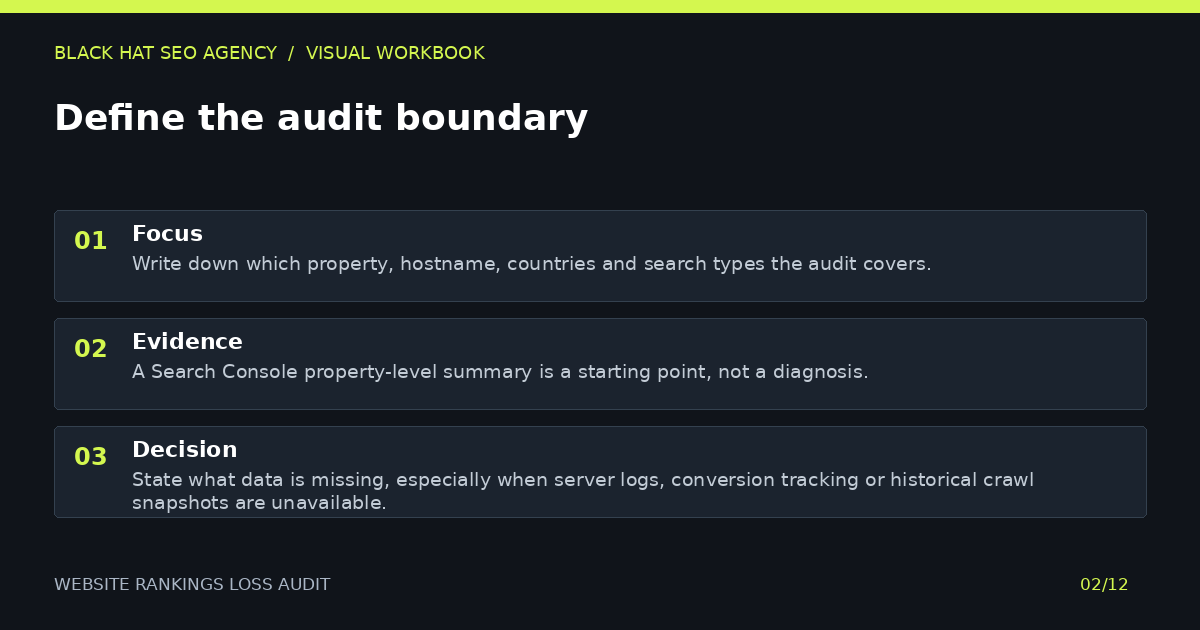
Write down which property, hostname, countries and search types the audit covers. Record the dates when the loss began and select comparable before and after windows. A Search Console property-level summary is a starting point, not a diagnosis. Separate a seasonal demand decline from a technical deployment or a shift in the pages receiving impressions. Preserve the original exports so another reviewer can reproduce your comparison. State what data is missing, especially when server logs, conversion tracking or historical crawl snapshots are unavailable.
Create a page-level evidence register
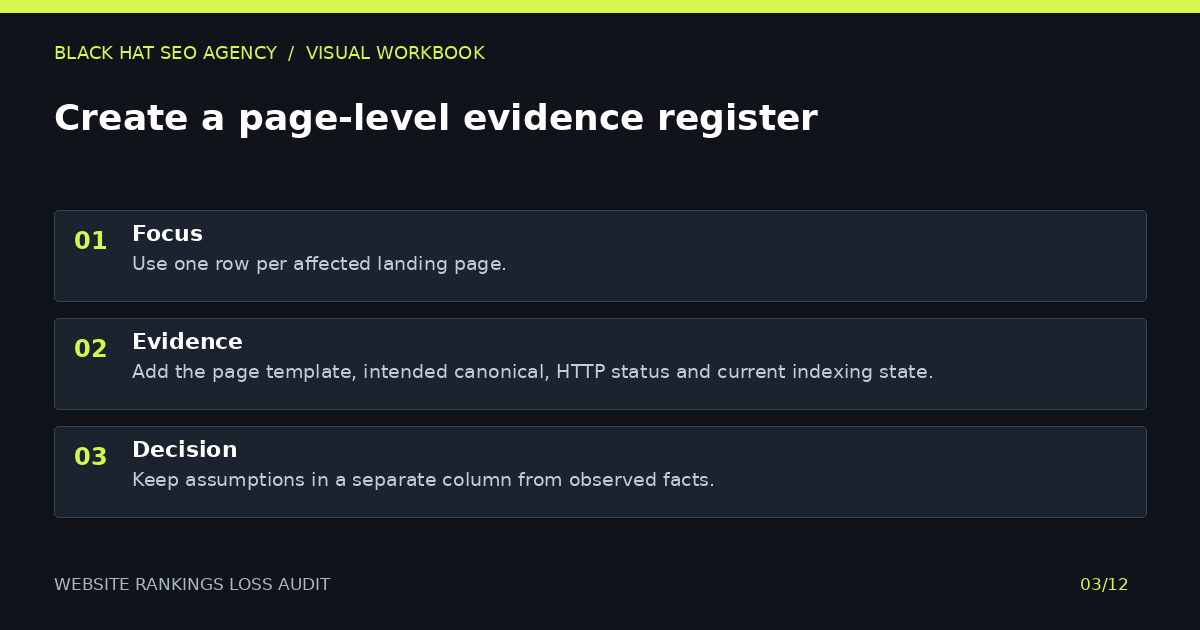
Use one row per affected landing page. Include before and after clicks, impressions, CTR and average position, together with the relevant query group. Add the page template, intended canonical, HTTP status and current indexing state. Prioritize pages that matter to qualified enquiries or useful reader journeys rather than only those with the largest impression totals. A large percentage fall on a page with very little traffic can be less urgent than a smaller fall on a core landing page. Keep assumptions in a separate column from observed facts.
Continue with our Google ranking suddenly dropped 2026 guide for a related perspective. Check its scope and publication context before applying any recommendation.
Test technical hypotheses
Check whether lost URLs share redirects, parameter rules, rendering dependencies or recently changed navigation. Compare a failing page with a stable page from the same template. Inspect canonical targets and confirm that they serve the intended content. Review sitemap inclusion and internal links, but remember that a sitemap submission does not force indexing. Check access and error logs when available to understand server failures and crawler requests. Record the test, the result and the remaining uncertainty instead of declaring a technical cause from a single screenshot.

Review usefulness and overlap
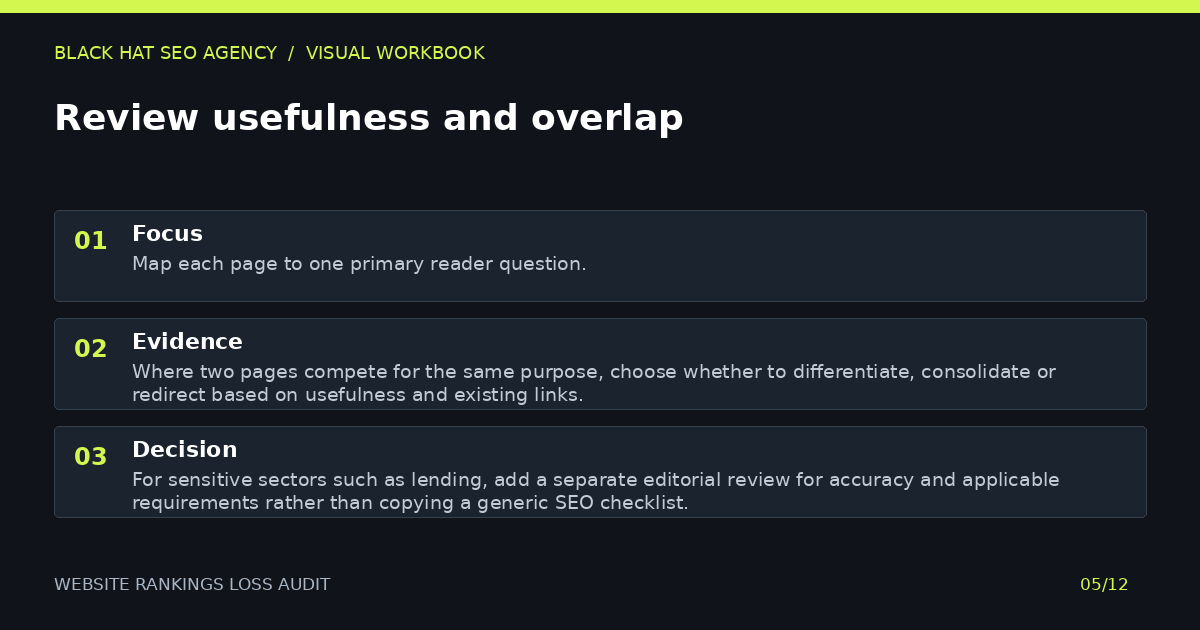
Map each page to one primary reader question. Similar titles are not enough to prove harmful overlap; examine whether pages answer the same task with substantially the same material. Where two pages compete for the same purpose, choose whether to differentiate, consolidate or redirect based on usefulness and existing links. Preserve useful information during consolidation. Review unsupported claims, outdated instructions and weak sourcing. For sensitive sectors such as lending, add a separate editorial review for accuracy and applicable requirements rather than copying a generic SEO checklist.
Continue with our Google ranking dropped dramatically 2026 guide for a related perspective. Check its scope and publication context before applying any recommendation.
Deliver a prioritized repair plan
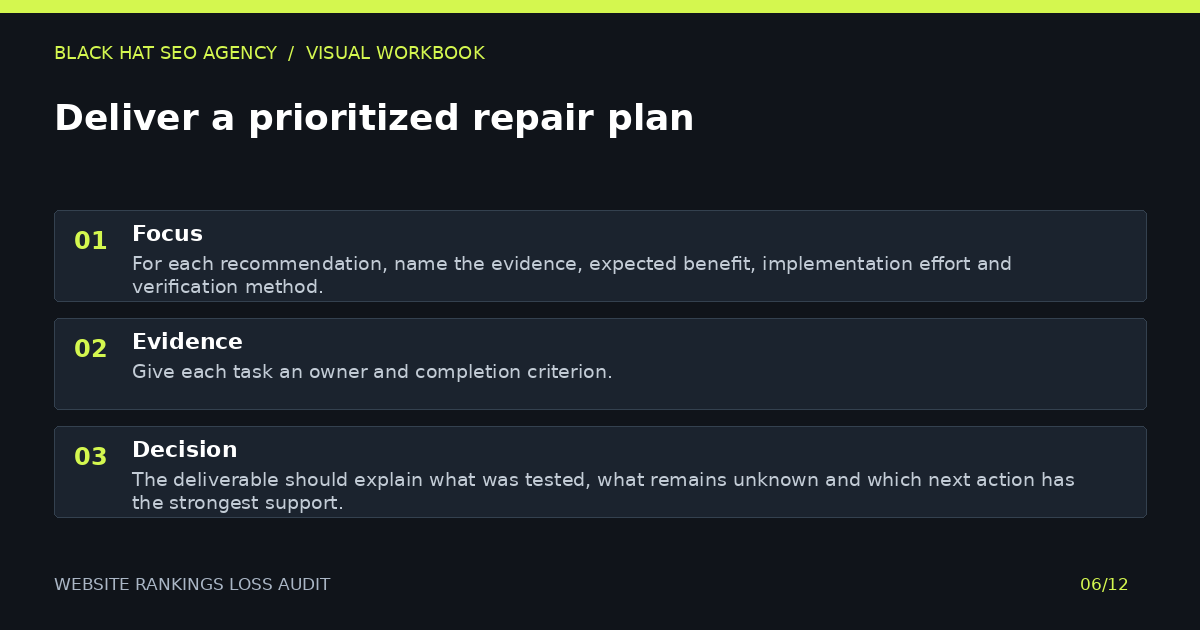
For each recommendation, name the evidence, expected benefit, implementation effort and verification method. Put confirmed crawl or indexing blockers ahead of cosmetic edits. Give each task an owner and completion criterion. Keep an untouched baseline export and a dated record of deployments. Recheck the same page and query cohorts after enough data accumulates. Do not promise a recovery date from an audit alone. The deliverable should explain what was tested, what remains unknown and which next action has the strongest support.
Practical review checklist
- Save a baseline with consistent dates and filters.
- Choose one testable question and collect supporting evidence.
- Assign an owner and record exactly what changes.
- Verify implementation before interpreting performance.
- Review results and document remaining uncertainty.
Questions about website rankings loss audit?
Use WhatsApp or Telegram for questions about this resource, the audit sequence or implementation checklist.
Related reading
These ten existing URLs come from the supplied Search Console export, ordered differently across the five guides. The lending resource is sector-specific; the update article is an existing reference, not independent confirmation of an update.
Frequently asked questions
What should I check first?
Write down which property, hostname, countries and search types the audit covers.
Does this approach guarantee visibility?
No. Indexing, ranking and AI-answer inclusion are not guaranteed. Use a documented baseline and review evidence over time.
How should I evaluate progress?
Compare consistent page and query cohorts, keep a dated change log and distinguish observations from assumptions.
Which report metrics are useful?
Review clicks, impressions, CTR and average position together, keeping the date range and filters consistent.
Search Console glossary
- Impressions
- The number of times a result was shown, as recorded in the selected Search Console report.
- Clicks
- Visits initiated by clicks recorded in the selected Search Console report.
- CTR
- Clicks divided by impressions for the same report scope.
- Average position
- An aggregated position metric for the impressions recorded in the report.
Visual implementation workbook
Use these six worksheets to turn the guidance into a documented review. Each graphic covers a different stage; record your own site evidence alongside it.
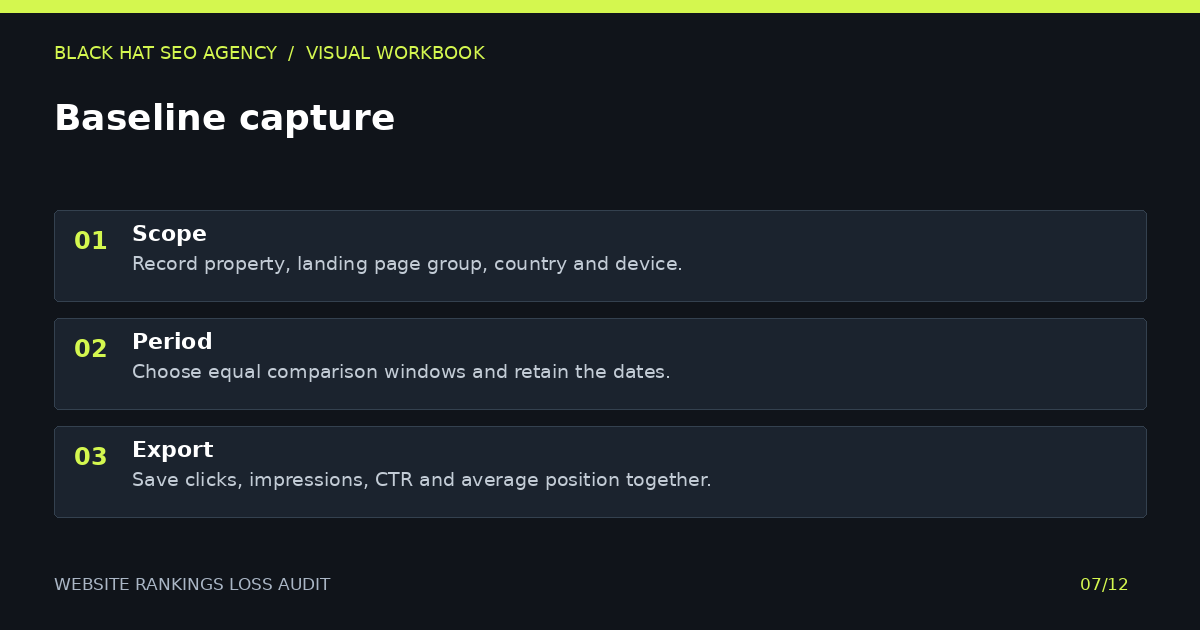


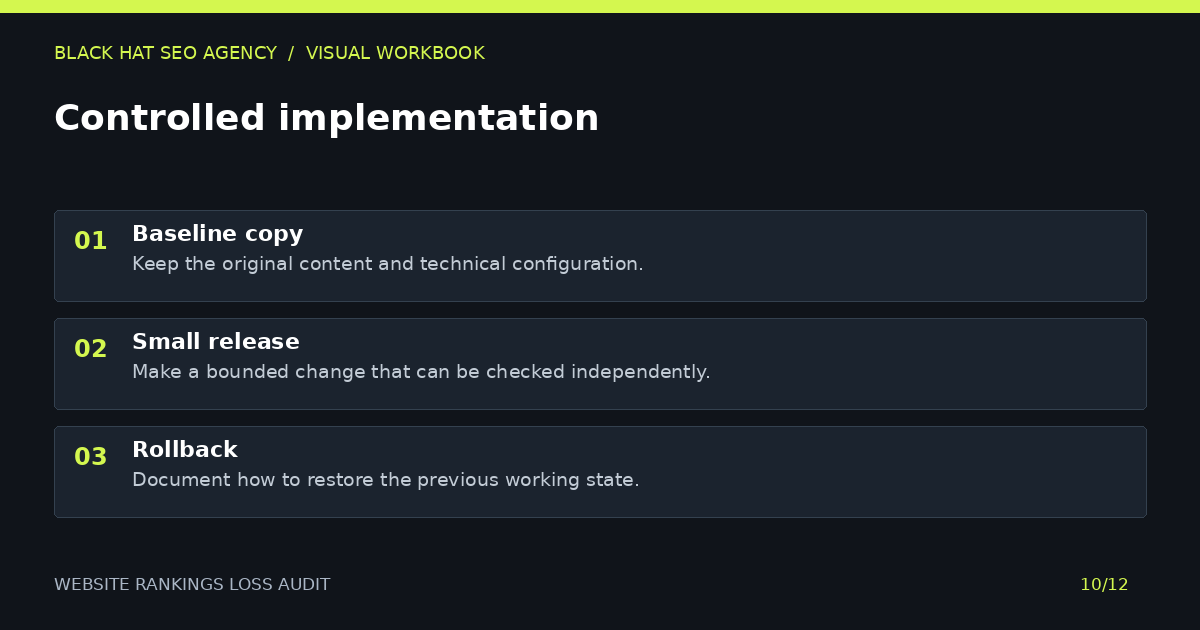


Image credit and reuse
These twelve original guide graphics were prepared for Black Hat SEO Agency. Credit: Black Hat SEO Agency — original guide artwork. They illustrate this article and its implementation workbook. For permission to reproduce or adapt a graphic, identify the image and contact the agency using the contact links on this page. No third-party stock photography is included.
Download the companion PDF
Keep the complete guide, review checklists and related resources in a printable format.
Open PDF Download PDFOfficial sources
About this resource
Prepared for Black Hat SEO Agency. This guide focuses on website rankings loss audit and supports evidence-based review and implementation decisions.