Blackhat SEO Software: Evaluate Tools Before They Touch Your Site
A practical review framework for automation, access permissions, link tools and search-policy exposure.
Table of contents
Use this 5-minute decision tree first
| Signal | First check | Next action |
|---|---|---|
| Visibility changed | Segment pages, queries and dates | Confirm scope before changing anything |
| URLs missing from search | Indexing, robots, canonical, HTTP | Fix technical eligibility first |
| Pages indexed but weaker | Intent, content, competition, authority | Prioritise evidence-supported improvements |
| Unclear cause | Change log and second opinion | Run controlled tests |
Separate capability from marketing
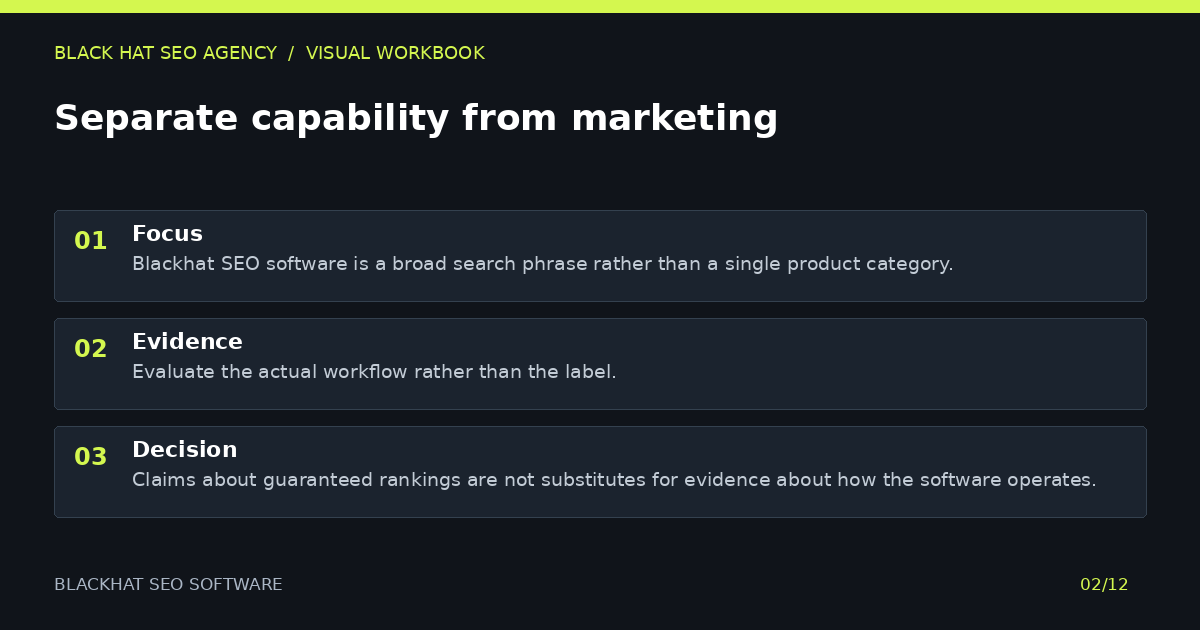
Blackhat SEO software is a broad search phrase rather than a single product category. Some tools crawl pages, organize data or check links; others automate manipulative publishing and link placement. Evaluate the actual workflow rather than the label. Ask what the tool changes, where it publishes, which credentials it requires and whether you can inspect its output. A vendor demonstration should show inputs, logs and reversibility. Claims about guaranteed rankings are not substitutes for evidence about how the software operates.
Review permissions before connecting
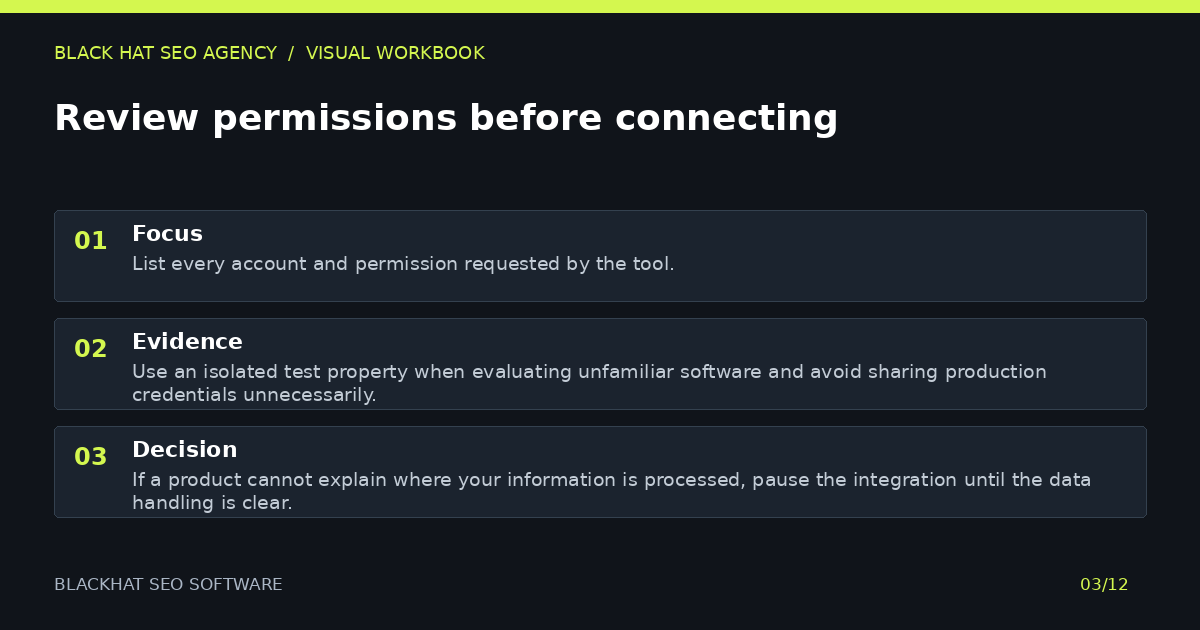
List every account and permission requested by the tool. A read-only audit generally needs less access than a deployment system. Use an isolated test property when evaluating unfamiliar software and avoid sharing production credentials unnecessarily. Check whether access can be revoked, exports can be retained and changes can be attributed to a user. Review retention terms before uploading customer or business data. If a product cannot explain where your information is processed, pause the integration until the data handling is clear.
Continue with our Google august 2026 spam update recovery for a related perspective. Check its scope and publication context before applying any recommendation.
Identify search-policy exposure
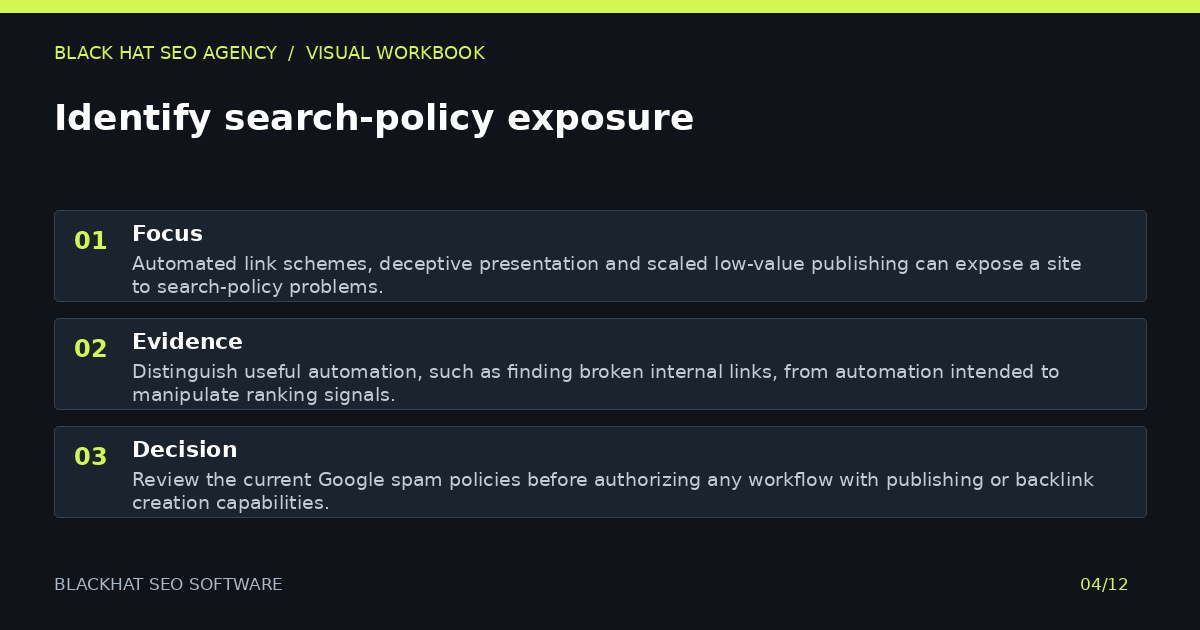
Automated link schemes, deceptive presentation and scaled low-value publishing can expose a site to search-policy problems. The existence of a tool does not make its recommended workflow appropriate. Distinguish useful automation, such as finding broken internal links, from automation intended to manipulate ranking signals. Require an explicit explanation of what will be published and why it helps readers. Reject fabricated reviews, hidden keyword blocks and misleading structured data. Review the current Google spam policies before authorizing any workflow with publishing or backlink creation capabilities.
Run a controlled evaluation
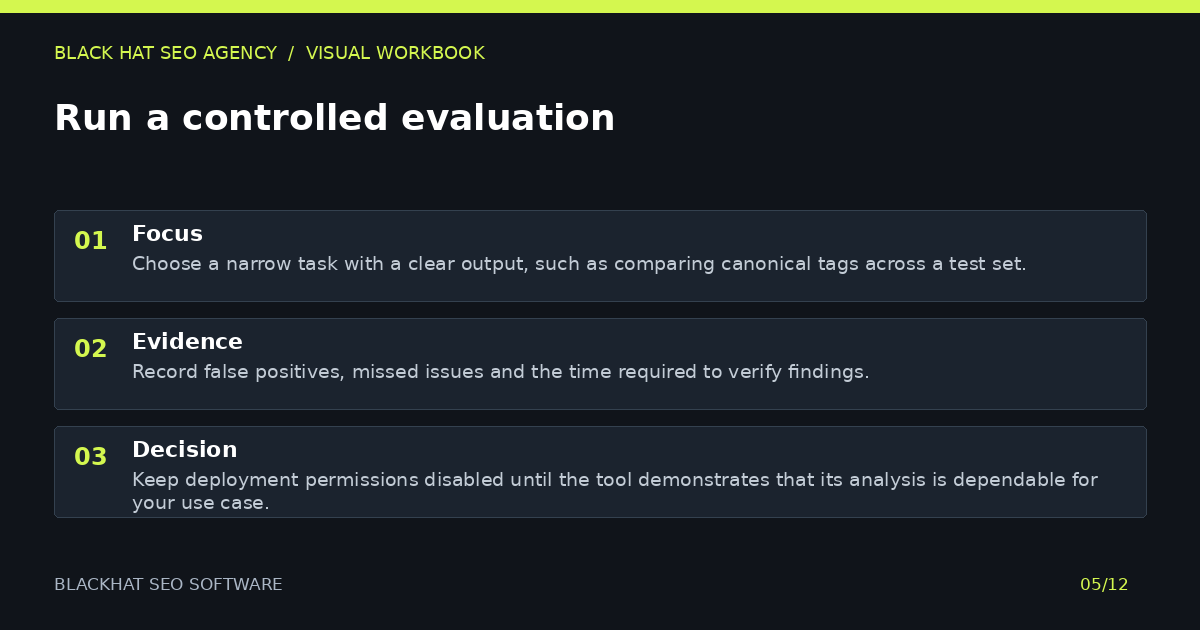
Choose a narrow task with a clear output, such as comparing canonical tags across a test set. Measure accuracy by manually reviewing a sample that includes edge cases. Record false positives, missed issues and the time required to verify findings. A fast crawl is not valuable if its recommendations are unreliable. Check whether exported data includes source URLs and timestamps so findings can be reproduced. Keep deployment permissions disabled until the tool demonstrates that its analysis is dependable for your use case.
Continue with our How to recover google ranking drop for a related perspective. Check its scope and publication context before applying any recommendation.
Build a sustainable tool stack
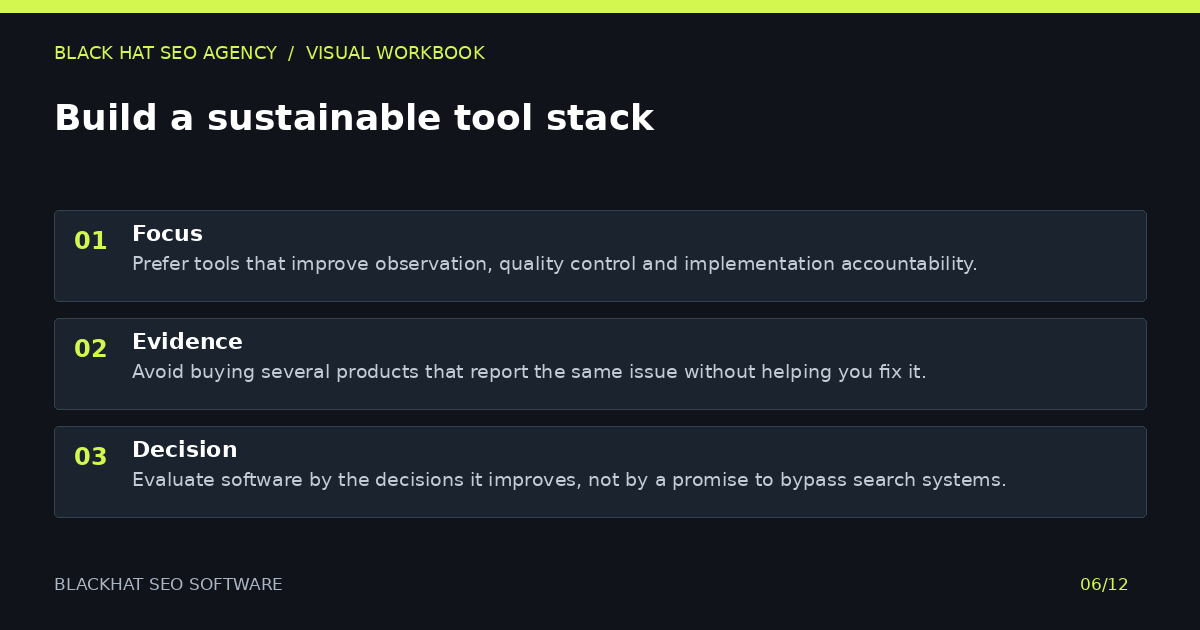
Prefer tools that improve observation, quality control and implementation accountability. Combine Search Console exports, a crawler, server monitoring and a documented release process according to your actual needs. Avoid buying several products that report the same issue without helping you fix it. Assign a person to review automated recommendations before changes reach important pages. Keep a rollback path for technical edits and a changelog for content updates. Evaluate software by the decisions it improves, not by a promise to bypass search systems.
Practical review checklist
- Save a baseline with consistent dates and filters.
- Choose one testable question and collect supporting evidence.
- Assign an owner and record exactly what changes.
- Verify implementation before interpreting performance.
- Review results and document remaining uncertainty.
Questions about blackhat seo software?
Use WhatsApp or Telegram for questions about this resource, the audit sequence or implementation checklist.
Related reading
These ten existing URLs come from the supplied Search Console export, ordered differently across the five guides. The lending resource is sector-specific; the update article is an existing reference, not independent confirmation of an update.
Frequently asked questions
What should I check first?
Blackhat SEO software is a broad search phrase rather than a single product category.
Does this approach guarantee visibility?
No. Indexing, ranking and AI-answer inclusion are not guaranteed. Use a documented baseline and review evidence over time.
How should I evaluate progress?
Compare consistent page and query cohorts, keep a dated change log and distinguish observations from assumptions.
Which report metrics are useful?
Review clicks, impressions, CTR and average position together, keeping the date range and filters consistent.
Search Console glossary
- Impressions
- The number of times a result was shown, as recorded in the selected Search Console report.
- Clicks
- Visits initiated by clicks recorded in the selected Search Console report.
- CTR
- Clicks divided by impressions for the same report scope.
- Average position
- An aggregated position metric for the impressions recorded in the report.
Visual implementation workbook
Use these six worksheets to turn the guidance into a documented review. Each graphic covers a different stage; record your own site evidence alongside it.
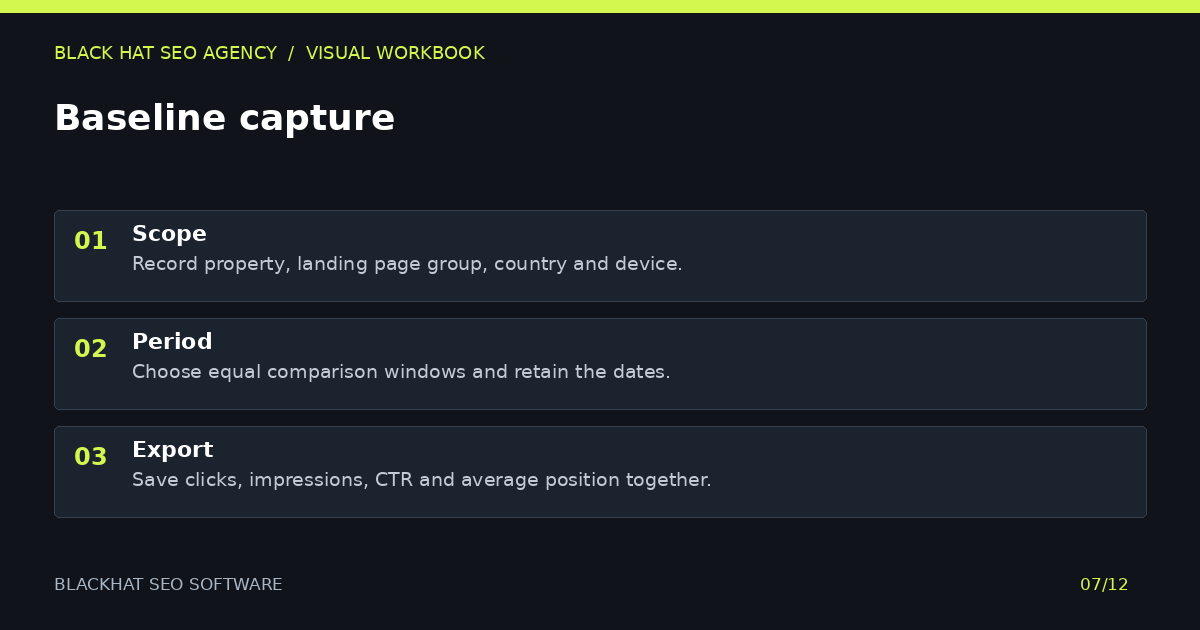
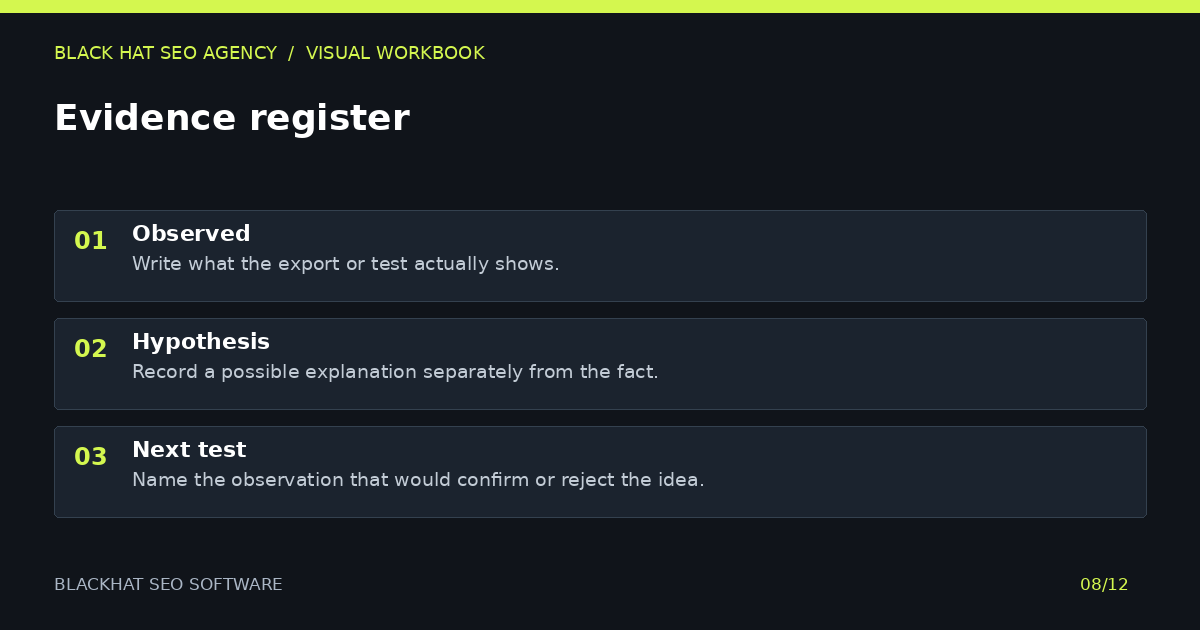
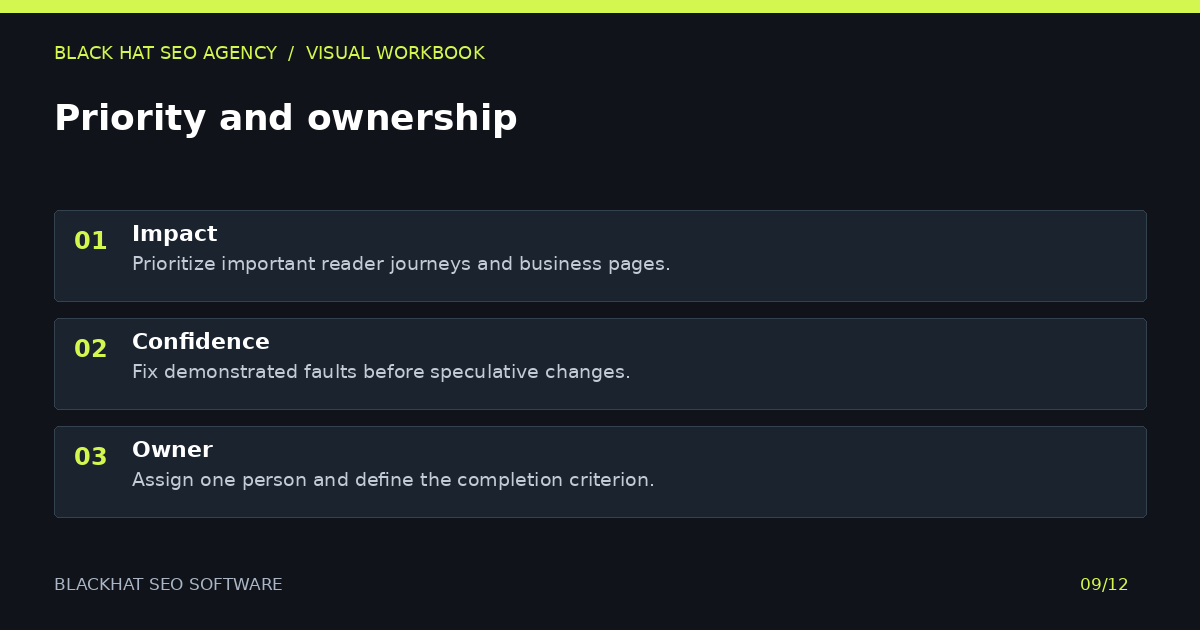
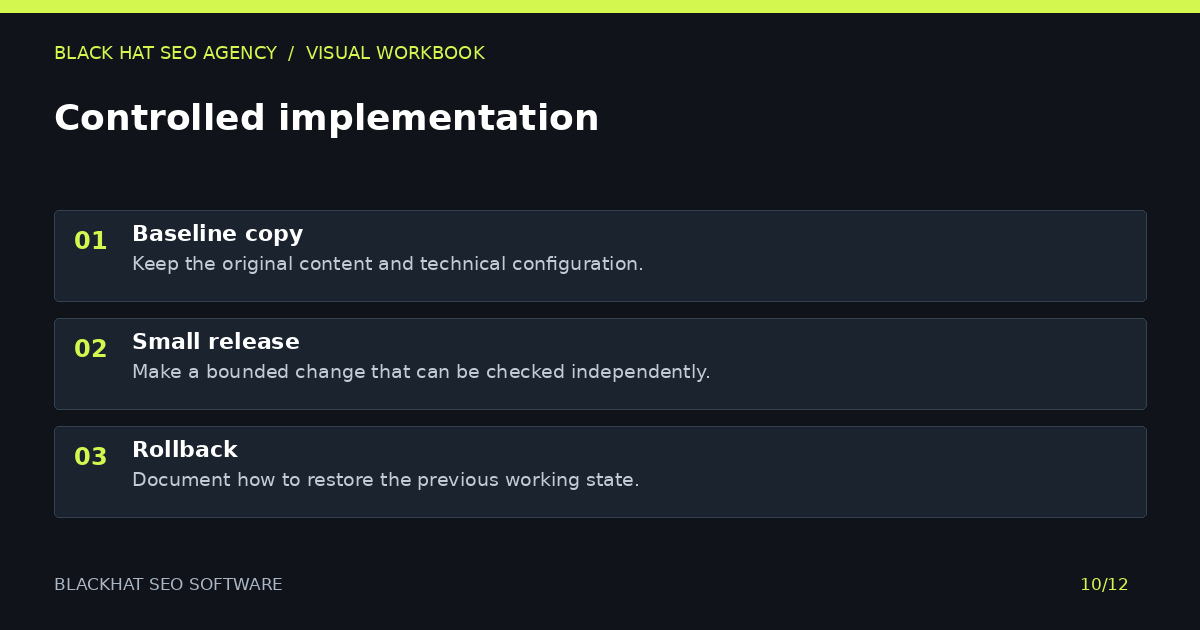
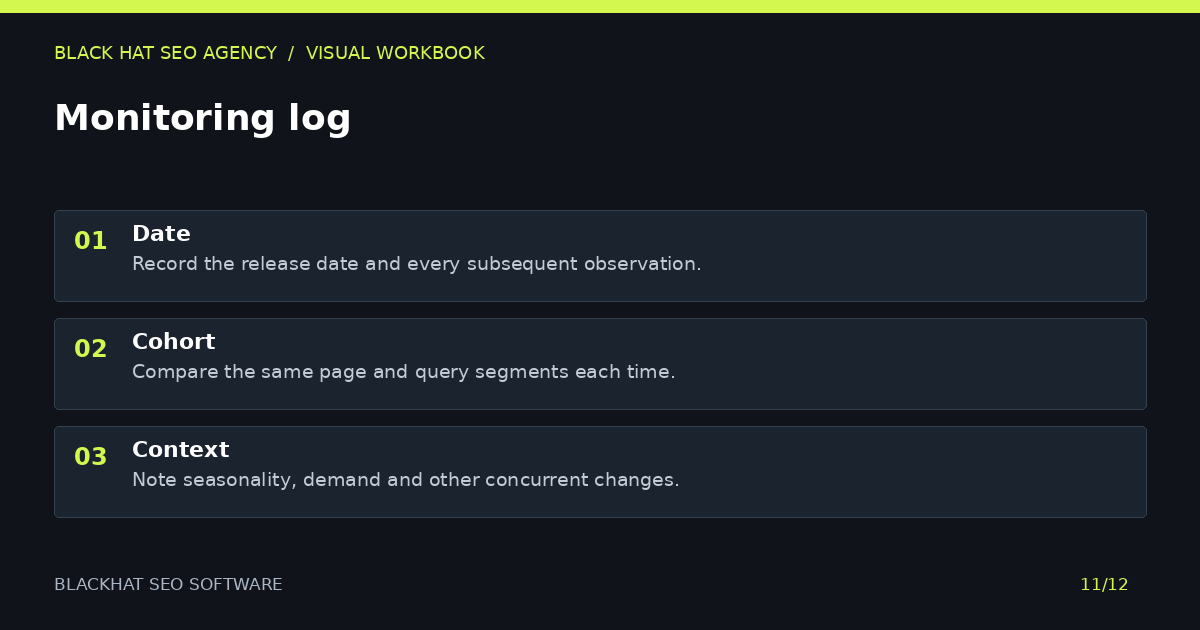
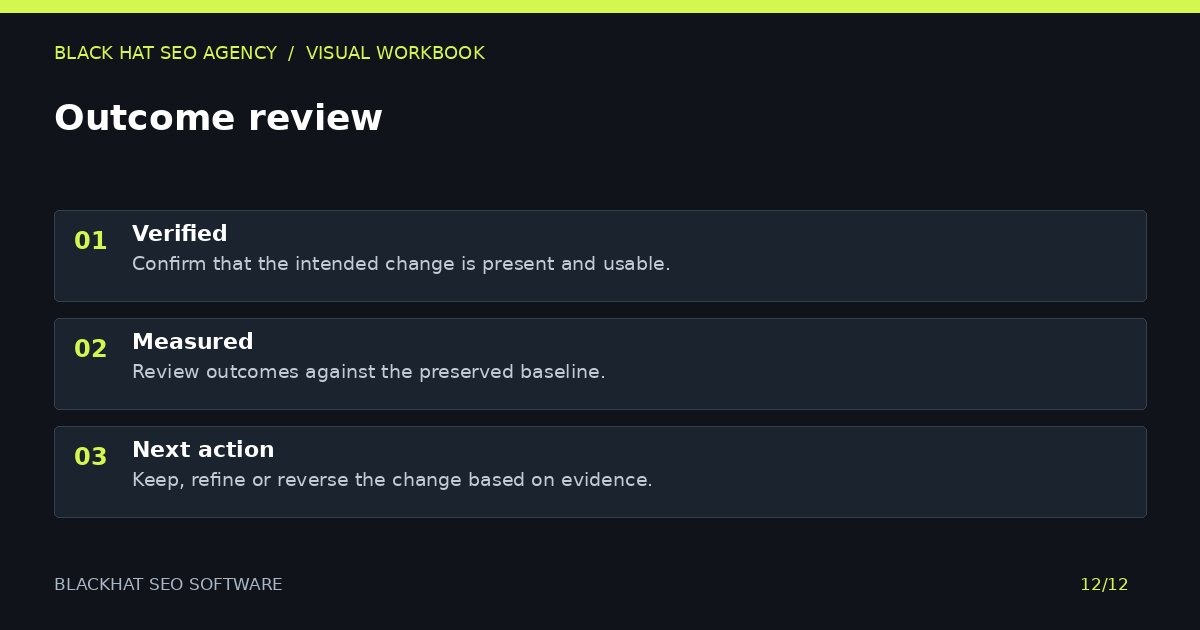
Image credit and reuse
These twelve original guide graphics were prepared for Black Hat SEO Agency. Credit: Black Hat SEO Agency — original guide artwork. They illustrate this article and its implementation workbook. For permission to reproduce or adapt a graphic, identify the image and contact the agency using the contact links on this page. No third-party stock photography is included.
Download the companion PDF
Keep the complete guide, review checklists and related resources in a printable format.
Open PDF Download PDFOfficial sources
About this resource
Prepared for Black Hat SEO Agency. This guide focuses on blackhat seo software and supports evidence-based review and implementation decisions.